misting system filtration

Misting System Filtration Guide

Filtration protects small nozzle passages, but filter selection must begin with the actual water source and system flow.

Water-source assessmentStaged filtration planningService and flushing access
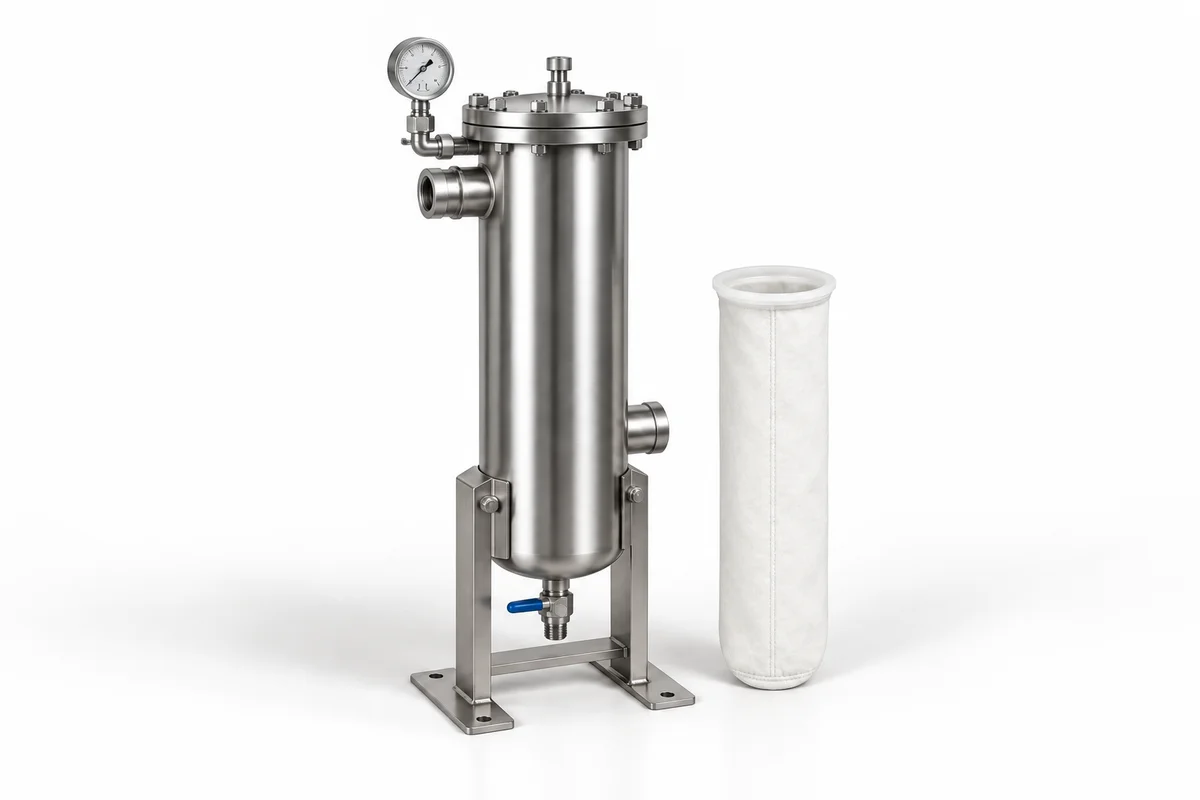
Configuration illustration of a stainless bag filter housing and a separate filter bag
AI-generated configuration illustration. Final equipment is specified in the agreed quotation.

Start with the water source

Identify mains, well, storage-tank, treated or recirculated water and any existing treatment. Review suspended particles, hardness and potential contamination before choosing the filter arrangement. The illustrated stainless bag filter housing uses a replaceable filter bag, not a pleated cartridge. Match bag dimensions, retaining ring, filter media and retention rating to the selected housing and water duty.

Specify removal performance, not just microns

Ask for the particle size, removal efficiency and test conditions behind the rating. Nominal and absolute labels alone do not provide a like-for-like comparison. Match the element to the pump and nozzle requirements and the actual water analysis.

  • Particle size and stated removal efficiency
  • Rated flow and clean-element pressure loss
  • Permitted differential pressure and replacement criteria
  • Element, seal and housing compatibility

Protect the pump without starving its inlet

Check the available inlet pressure at the required flow with clean and loaded filters. A restricted inlet filter can impair pump supply. Follow the selected pump manufacturer's inlet requirements and provide pressure monitoring and maintenance access.

Shared filtration or separate branches

Size a shared filter for the maximum permitted simultaneous demand, and consider what happens during cleaning or element replacement. Separate branches may simplify isolation but need their own flow and pressure-loss checks. Do not fit a low-pressure filter housing into a high-pressure discharge line.

Plan water treatment and service

Particle filtration alone does not remove dissolved hardness or establish microbiological safety. Review any treatment separately. Record filter pressure difference, element changes and flushing; set maintenance intervals from operating conditions and the equipment instructions.

  • Water source and available analysis
  • Nozzle model, system flow and filter location
  • Housing pressure and temperature limits
  • Safe isolation, depressurization and spare-element access

Related technical pages

Frequently asked questions

Why do new misting nozzles stop spraying soon after installation?

The timing alone does not identify the cause. Before ordering replacements, record whether one nozzle, one branch or the whole system is affected; note the water source, filter details, nozzle model, operating pressure and any recent installation or maintenance. Include whether the lines were flushed according to the equipment instructions. These details help review the problem without assuming every stopped nozzle needs replacement.

What should I report when a misting nozzle drips?

State whether it drips during operation or only after shutdown, whether other nozzles behave the same way, and when the symptom began. Send the nozzle model and a photo or short video with your inquiry. Dripping alone does not confirm a blockage or an anti-drip component fault; the operating conditions and supplied configuration need review.

Is a finer filter always better?

No. Excessive restriction can reduce the inlet supply, especially as the element loads. Choose the required retention performance with sufficient flow capacity and an acceptable pressure loss.

Will a particle filter prevent all nozzle deposits?

No. Dissolved minerals can still form deposits. Use the water analysis to determine whether separate treatment is required.

Can a nozzle's small screen replace the main filtration?

Do not assume it can. Review the pump's inlet requirements and the system's contamination load; a nozzle screen does not define the complete water-treatment arrangement.

Review your water and filtration

Send the water source, available analysis, system flow, nozzle type and maintenance constraints.

Discuss your project
WhatsApp Inquiry